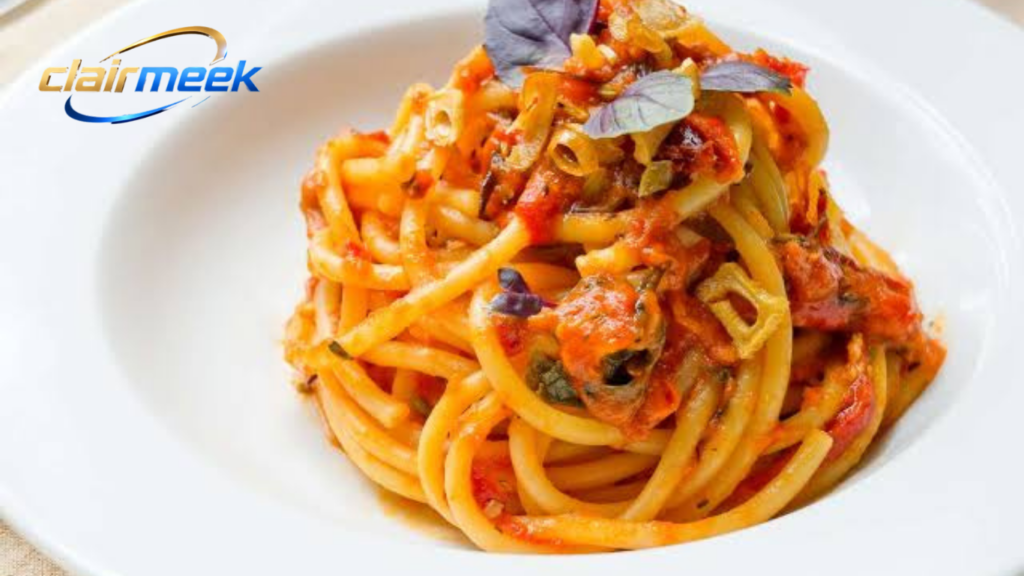

Bucatini pasta is one of those Italian shapes that quietly wins people over. Thicker than spaghetti yet pierced by a narrow tunnel running its full length, it looks almost ordinary until the first bite. Sauce slips inside as well as coating the outside, creating a richer mouthful than solid strands can offer. In Rome and across Lazio it has long been the preferred partner for robust, simple sauces, while cooks further afield have discovered its playful texture and practical advantages.
Readers keep returning to bucatini because it sits at the intersection of tradition and everyday pleasure. It is not the most delicate pasta, nor the most flamboyant, yet its combination of chew, sauce-holding ability and historical depth makes it memorable. Whether served in a Roman trattoria or stirred into a weeknight supper, it delivers satisfaction without pretension.
Origins and Early Background
The precise birth of bucatini pasta is difficult to pin down, as with many traditional pasta shapes. Most reliable accounts point to Sicily as its likely homeland. Medieval pasta makers there faced a practical problem: without efficient drying systems, thick strands cooked unevenly and took a long time. The solution was to roll small pieces of dough around a thin wooden or iron rod—sometimes compared to an umbrella spoke—then slide the pasta free, leaving a hollow centre. This allowed heat and water to reach the interior during cooking, producing more even results.
The fifteenth-century cook Martino da Como, in his De Arte Coquinaria, described “maccaroni siciliani” in terms that match this method: firm dough formed into thin sticks, pierced with a fine iron rod, then rolled and the rod removed. The shape later spread through the Kingdom of Naples and into central Italy. In the Lazio region, particularly Rome, it took firm root and became closely associated with local cooking. Sicilians sometimes still call similar handmade versions pasta e ferretti (“pasta with iron”).
Bucatini is made from durum wheat semolina and water—the classic southern Italian formula that yields a firm, golden dried pasta. No eggs are traditionally used. The name itself comes from the Italian buco, meaning hole, with bucato or the Neapolitan perciato conveying the idea of being pierced. Around Naples the same shape is often called perciatelli.
Characteristics, Production and Rise to Prominence
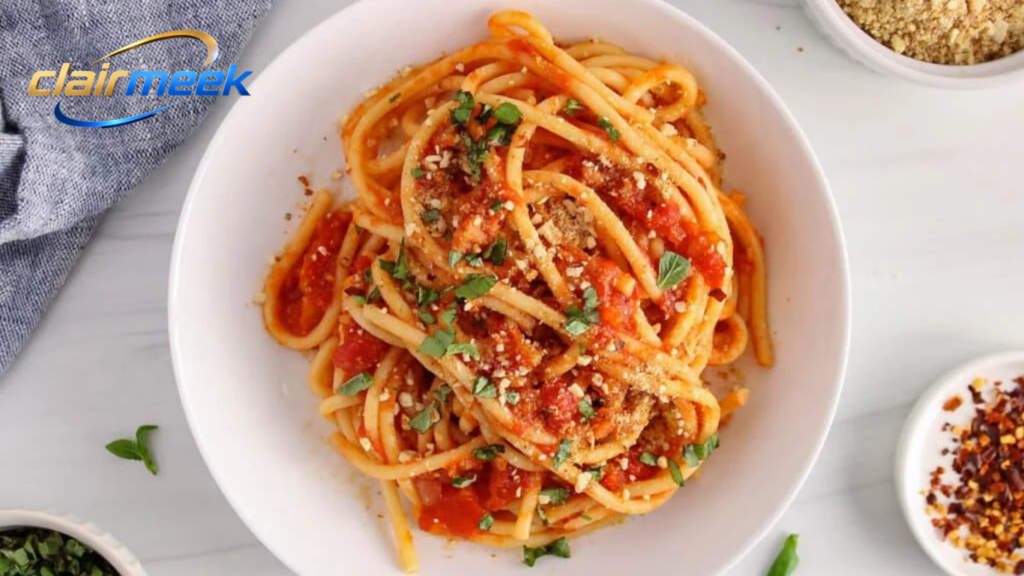
Modern bucatini is extruded rather than hand-rolled. Dough is forced through a die containing circular openings, each with a central pin that creates the continuous hole. Bronze dies, favoured by many artisanal producers, leave a slightly rough surface that helps sauce cling. Industrial Teflon dies produce a smoother finish. Typical dimensions are 25–30 cm long with an outer diameter of roughly 2.8–3 mm and a narrow internal hole of about 0.8–1 mm. Cooking time is usually eight to twelve minutes, often a little shorter than comparable solid spaghetti because the hollow centre allows water to circulate inside.
The shape’s breakthrough in wider culinary consciousness came through its association with Roman and Lazio dishes. Bucatini all’Amatriciana is the most famous pairing: a sauce of guanciale (cured pork jowl), tomato, Pecorino Romano and a touch of chilli or black pepper. The dish originated in the town of Amatrice, yet became a staple of Roman trattorias. The hollow strand traps the rich, slightly spicy sauce effectively while retaining a satisfying al dente bite. Bucatini also appears in carbonara, cacio e pepe and gricia, where its structure holds creamy or oily coatings better than thinner solid pastas.
Recognition has been steady rather than dramatic. It is not the most widely available long pasta outside Italy, yet chefs and home cooks prize it for its textural interest. In recent years bronze-drawn versions from established Italian brands have raised its profile among enthusiasts seeking authentic surface texture. Collaborations between pasta makers and restaurants have further highlighted its versatility with both traditional and modern sauces.
Practical Challenges and Turning Points
Like many specialised shapes, bucatini has faced supply hiccups. During the early months of the Covid-19 pandemic a notable shortage in the United States drew media attention. One widely reported factor involved regulatory checks on iron content in certain imported brands; competition and shifting demand also played roles. The episode reminded cooks how dependent they had become on this particular tube and prompted many to seek alternatives or homemade versions.
Production itself presents minor technical demands. Because the pasta must be extruded, small-scale or home makers without an extruder often revert to the older rod method or simply choose solid strands. Overcooking remains a risk; the hollow centre can soften more quickly if timing is ignored, so careful attention to the al dente stage is essential. These practical points have never dimmed its appeal; if anything they reinforce the sense that bucatini rewards a little extra care.
Culinary Life and Public Reputation
Bucatini has no personal biography in the human sense, yet its public life is well documented through cookbooks, restaurant menus and family tables. It is firmly linked to central Italian cooking, especially Rome, while retaining Sicilian roots. Outside Italy it has found favour among pasta lovers who appreciate its ability to carry robust flavours without becoming limp. Public statements from chefs often emphasise the pleasure of the slight “whistle” or bounce the strands can give when lifted from the plate, and the way sauce appears both inside and out.
No reliable sources attribute celebrity romances or private dramas to a pasta shape. Its reputation rests on consistent performance in the kitchen and a place in the classic Roman quartet of pasta dishes.
Later Uses and Current Presence
Today bucatini appears on menus far beyond Lazio. Chefs pair it with pesto, seafood sauces, vegetable ragùs and even experimental combinations involving beer cheese or hazelnut pesto. Artisanal producers continue to offer bronze-die versions that emphasise texture. Home cooks increasingly seek it for both traditional amatriciana and simpler olive-oil or butter-based preparations.
Online recipe sites and food writers regularly feature it, keeping the shape visible to new generations of cooks. Its presence in supermarket aisles remains patchier than spaghetti, which only heightens the satisfaction when a packet is found.

Quick Bio
| Detail | Information |
| Full Name | Bucatini (also known as perciatelli) |
| Approximate Origin | Sicily, later popularised in Lazio (esp. Rome) |
| Place of Origin | Italy |
| Nationality | Italian |
| “Profession” | Long tubular pasta |
| Years Active | Documented from at least the 15th–16th centuries to the present |
| Known For | Hollow centre; classic pairing with Amatriciana sauce |
| Typical Composition | Durum wheat semolina and water |
Conclusion
Bucatini pasta remains important because it solves a practical problem elegantly and delivers a distinctive eating experience. Its influence lies less in dramatic innovation than in steady service to Italian regional cooking. The hollow form pioneered a principle later seen in many tubular shapes, while its rough bronze-drawn surface exemplifies the traditional preference for sauce adhesion. Public perception treats it as a reliable, slightly whimsical classic—neither obscure nor ubiquitous.